Cultivated seagrass is set to save the ecosystem of the Dutch Caribbean
Cultivating coral is now well within the grasp of aquarists, but the same cannot yet be said for seagrass – a small plant that is rapidly disappearing from the wild. Scientists at the UvA are collaborating with Artis to learn how to cultivate tropical seagrass. “Cultivating seagrass is even more difficult than cultivating coral.”

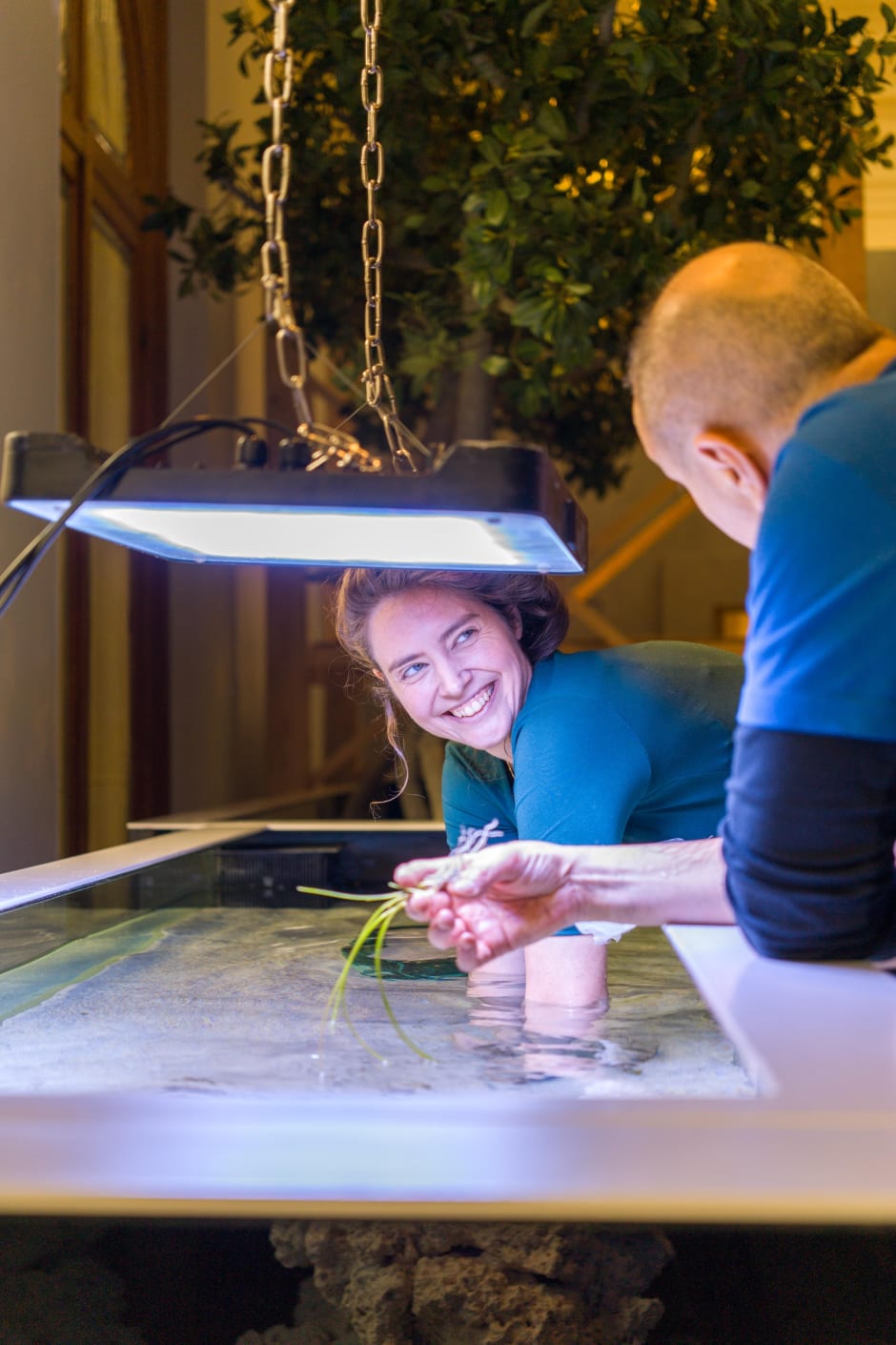
Visitors are peering at the swaying, green blades in the aquarium at Artis. Since the opening of the new Artis aquarium in June, this has been the first aquarium to feature tropical seagrass. UvA aquatic biologists Arie Vonk and Fee Smulders personally transported the plants from Curaçao in January.
Seagrass is crucial to the ecosystem in the Dutch Caribbean. The plant stores CO2 in the seabed, provides a hiding place for rays, sharks and other fish, and purifies the water, which in turn benefits coral reefs. But just as with coral reefs, seagrass is in a poor state. Every hour, an area of seagrass equivalent to two football pitches disappears from the seabed. This is why UvA researchers, together with aquarists from Artis, want to learn how to cultivate the plant and eventually replant it.
Tropical ecosystem
The seagrass at Artis is nestled between an aquarium featuring mangrove forests and a coral reef under construction. “With this, we want to tell the story of a tropical ecosystem like that found in the Dutch Caribbean,” explains Artis curator and UvA alumnus Alex Huiberse. “From the beach, you can see the mangrove forests, with the seagrass beds behind them that purify the water,” adds Smulders. “This benefits the coral, which lies further out to sea. The coral, in turn, acts as a breakwater for the seagrass.”
“It would also be really nice if we could open up the aquariums at Artis to make it one big aquarium,” continues Smulders, who recently won a Veni grant that will enable her to conduct research into seagrass at the UvA from January onwards. “But that’s also complicated: if the seagrass carries even a single harmful bacterium, the coral could die in an instant.”
Coral reef under construction
Building a coral reef in an aquarium is, in fact, a delicate business. Corals are sensitive creatures that grow slowly and react strongly to bacteria and pollution in the water. That is why there are still very few corals on display at Artis. “People assume that an aquarium will open and the coral reef will simply be there again,” says Huiberse. “But you have to build a reef bit by bit to restore balance to the entire ecosystem.”
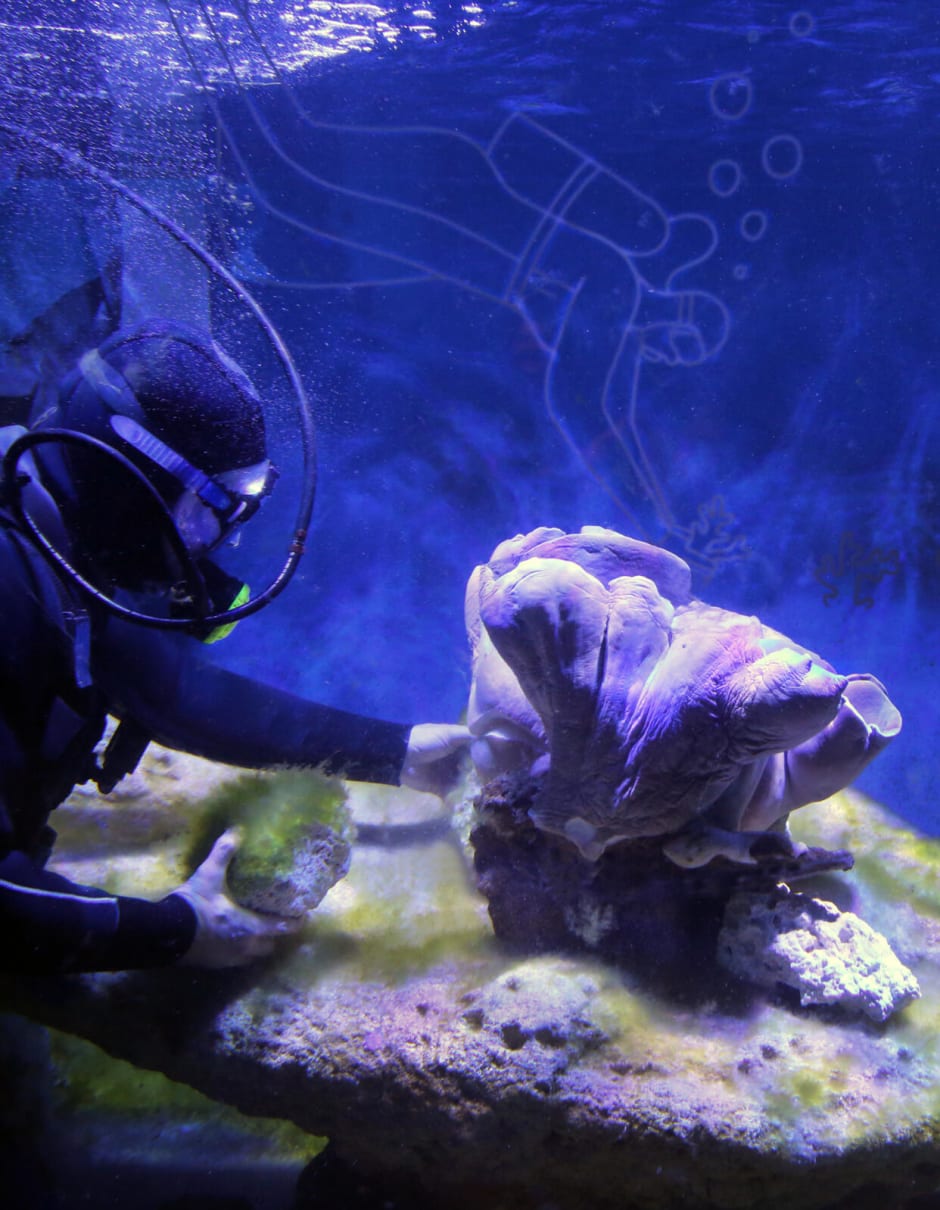
According to Huiberse, this isn’t particularly difficult for aquarists. “If you have the right water quality, lighting and water flow, you can build the foundation using bare rocks. On top of that, you place ‘live rocks’: rocks that have been part of a coral reef for a long time and are teeming with sponges and other tiny organisms such as viruses and bacteria.”
After a period of algae growth, divers will place pieces of coral on the stones, which will grow into a reef over the course of ten years. So, over the coming years, you’ll be able to follow the growth of this coral reef at Artis live. This will happen more quickly than the growth of an entirely new reef. This is because Artis can draw on its collection of corals from the old aquarium, which are stored in a temporary aquarium beneath the Artis office building.
Pioneering
“Cultivating seagrass is even more complicated than coral,” says Smulders. Coral has, in fact, been cultivated in aquariums for over fifty years, whilst seagrass has only recently become a subject of research. “Partly because it doesn’t look as attractive.”

In January, Smulders planted three species of tropical seagrass at Artis. By early September, two species were still alive. “That’s a decent result in itself,” says Smulders, although she believes the seagrass isn’t doing particularly well yet. “We’d prefer to see it grow a bit faster and form a somewhat denser bed. We haven’t managed that in the lab either.”
“Cultivating seagrass is truly pioneering work,” Smulders continues. “During my PhD in Wageningen, we cultivated seagrass in the lab and it took a very long time before we got the hang of it. It stayed alive but didn’t produce very many new leaves.”
Smulders isn’t yet able to say exactly what the problem is. “It may be that the seagrass is struggling with the nutrient-rich water from the Oosterschelde. Just like corals, seagrass prefers as few nutrients in the water as possible; otherwise, the algae will take over. But it could also be down to the wave action or the biodiversity of the fish, fungi and microbes around it.”
Cultivation stations
If researchers can crack the seagrass code, this will yield interesting information. Not only for science, but also for nature conservationists and other aquariums worldwide. This will also bring large-scale seagrass cultivation a step closer. Smulders: “If we discover how seagrass grows well at Artis, we could, for example, set up seagrass breeding stations in the Caribbean to aid seagrass restoration. Although I always add that it is better to protect seagrass in the wild than to replant it. Seagrass restoration is, in fact, very difficult.”
This is already happening with coral. Some aquariums are already working on cultivating endangered coral species and reintroducing them. Geolocation is used to determine very precisely which species comes from where. After all, you can’t simply reintroduce corals into another reef. For Artis, it is still too early for that. Huiberse: “You shouldn’t attempt that in a new aquarium; first we need to know whether the balance in the ecosystem here is right. We do want to contribute to this, but it will take another ten to fifteen years.”
It’s not quite time for the seagrass either. However, Smulders believes that, with the help of the expertise of Artis’s experienced aquarists, they will be able to achieve breakthroughs more quickly. In the coming period, experiments will be carried out using snails that eat the algae on the seagrass and additional pumps to create water movement. Smulders: “I hope that by Christmas we’ll have a somewhat fuller field. And that would be great, because then we could also start conducting research with students.”