Sport | USC has been “embraced by a large and diverse group of UvA athletes” for fifty years

It took a decade of bureaucratic wrangling, but in 1976 the University Sports Centre of the UvA finally came into being. Fifty years later, the USC has grown into the largest sports organisation in Amsterdam. “It was a logistical nightmare.”
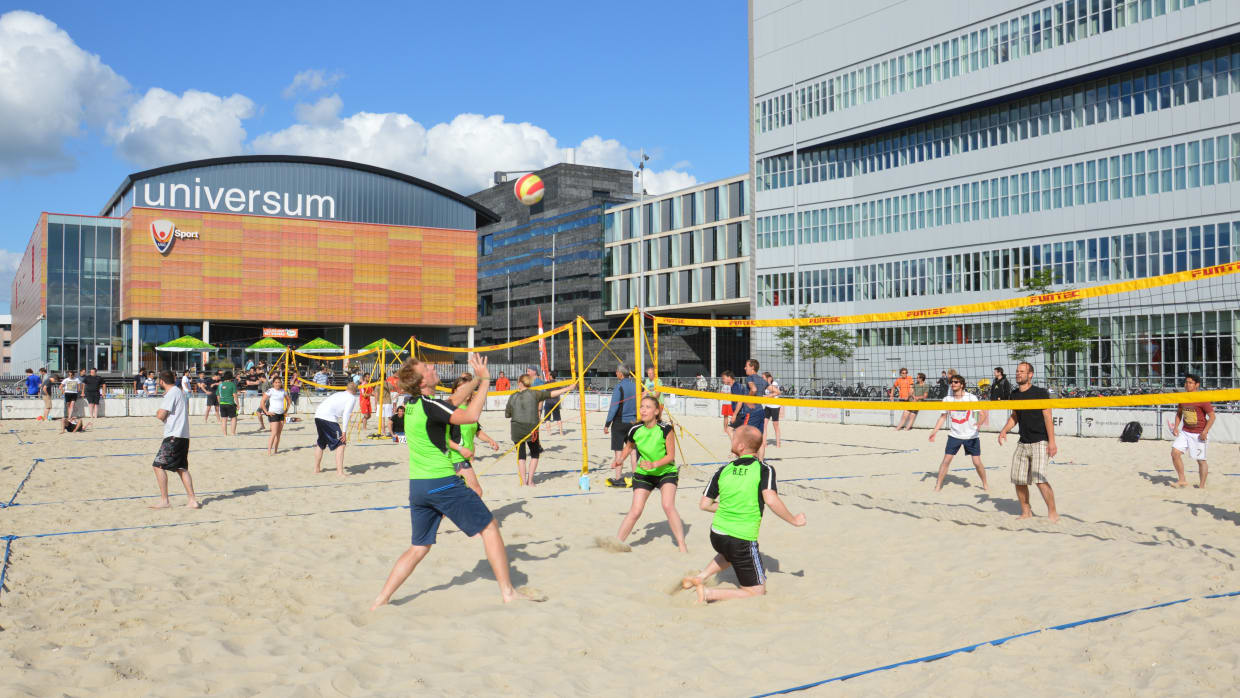
It is the spring of 1974, and while the rest of Europe is captivated by freshly crowned Eurovision sensation ABBA, the University of Amsterdam begins construction of its own sports centre. Almost two years after the first pile is driven into the ground, the champagne can be uncorked on 5 May 1976: on that day, the University Sports Centre (USC) of the UvA is officially opened. Today, exactly fifty years ago, the very first students worked up a sweat there.
At that time, sport was not yet taking place at Science Park – the move to that location would not happen until 2010 – but at De Boelelaan in Amsterdam-Zuid. At first glance, that seems an illogical location for a UvA facility, being much closer to the VU than to its own home base, but the decision to establish it on the Zuidas was the result of years of bureaucratic wrangling.
Logistical nightmare
“It was a logistical nightmare,” says sports historian Jurryt van de Vooren. “There were so many decision-making bodies involved in the creation of that sports centre. At one point, the executive board suddenly lost all interest, then a construction ban was imposed by a ministry, and later the student union Asva also opposed it. And on top of that, the municipality had a say in every little thing. There was always some party making things difficult.”
The disputes between all parties involved meant that the UvA only managed to organise central sports facilities for its students ten years later than many other universities in the Netherlands – including the VU –, and that the preferred location in the Watergraafsmeer was rejected by the municipality. And so De Boelelaan became the chosen site.
Fortunately, the distance between campus and sports centre did not prove to be a major problem. The USC was quickly embraced by a large and diverse group of UvA students. “The facilities were widely used from the outset,” Van de Vooren explains. “Indoor football and volleyball were very popular in those early years; the halls were packed. And at the time, the university was ahead of the curve when it came to individual sports such as strength training and fitness. That fitted perfectly with student life, where attendance can fluctuate due to exam periods and holidays. In mainstream sports clubs, you can’t really afford that, but in student sport, you can.”

Broken wrists
In its early years, the USC had a somewhat bureaucratic and administrative character, partly because policy was still directed from the Maagdenhuis, where there was little practical knowledge of sport. “For example, the walls were placed too close to the edges of the pitch, which meant students regularly broke their wrists when they collided with them,” Van de Vooren explains.
This changed during the 1990s, when the sports centre gained greater independence and the focus increasingly shifted towards the practical needs of students, as former director Theo van Uden recalls: “When I joined in 1996, the USC was not yet the vibrant sports organisation it would later become. We increasingly started to focus on our users; for instance by opening at weekends and during holidays, and by responding to trends in the world of sport.”
Twenty thousand members
In order to grow into the largest sports organisation in Amsterdam (with more than twenty thousand members), the USC had to continually reinvent itself in the years that followed. In competing for students’ limited time and attention for example, it had to contend with the city’s vibrant nightlife. “The USC has always had to stay closely attuned to the latest trends and the needs of students, because in Amsterdam there is so much more to do than just sport,” says sports historian Van de Vooren.
Throughout this jubilee year, the USC is organising activities to celebrate its fiftieth anniversary. For instance, live music will be featured in all gyms every fiftieth day of the year, and a major sports tournament will be held in November. The official celebration will take place on 19 June.
It is a reality that Natasja Bikkel, the current director of the USC, is well aware of. “We have to stay very alert to the latest developments in the fitness industry and make sure we don’t fall behind. At the same time, we have never positioned ourselves as a generic gym; we really want to create a student atmosphere,” she emphasises. “We are here to contribute to a positive study experience by giving students the opportunity to work on their mental and physical health. In particular, the focus on mental health has increased over the past fifty years, as the pressure on young people has only grown.”
And so, there should be sports facilities nearby for every student, that has always been the USC’s guiding principle. “The gym that will open in the summer of 2027 in the J/K building at REC is a great example of this,” says Bikkel. “It’s something we have fought for over many years, so we’re very pleased that a new location will be opening there. Our vision for the future is that, over the next fifty years as well, we want to be there for all students in Amsterdam. To achieve that, we need to be close to students and close to campus.”