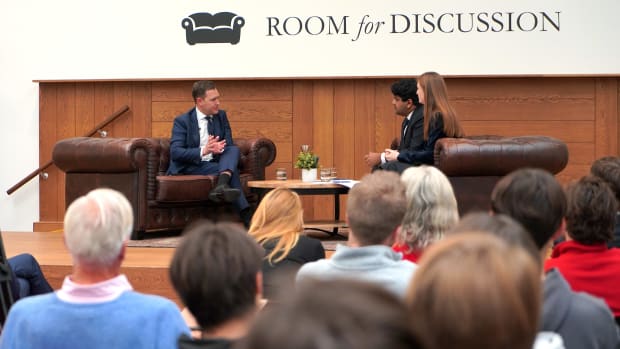
Minister Eelco Heinen at Room for Discussion: “Budget cuts are necessary”

Innovation, budget cuts and fiscal discipline, if it were up to Eelco Heinen, these would be the key priorities for the years ahead. The caretaker finance minister appeared at Room for Discussion (RfD) with a clear message: the Netherlands faces difficult choices, and he is not afraid to make them.

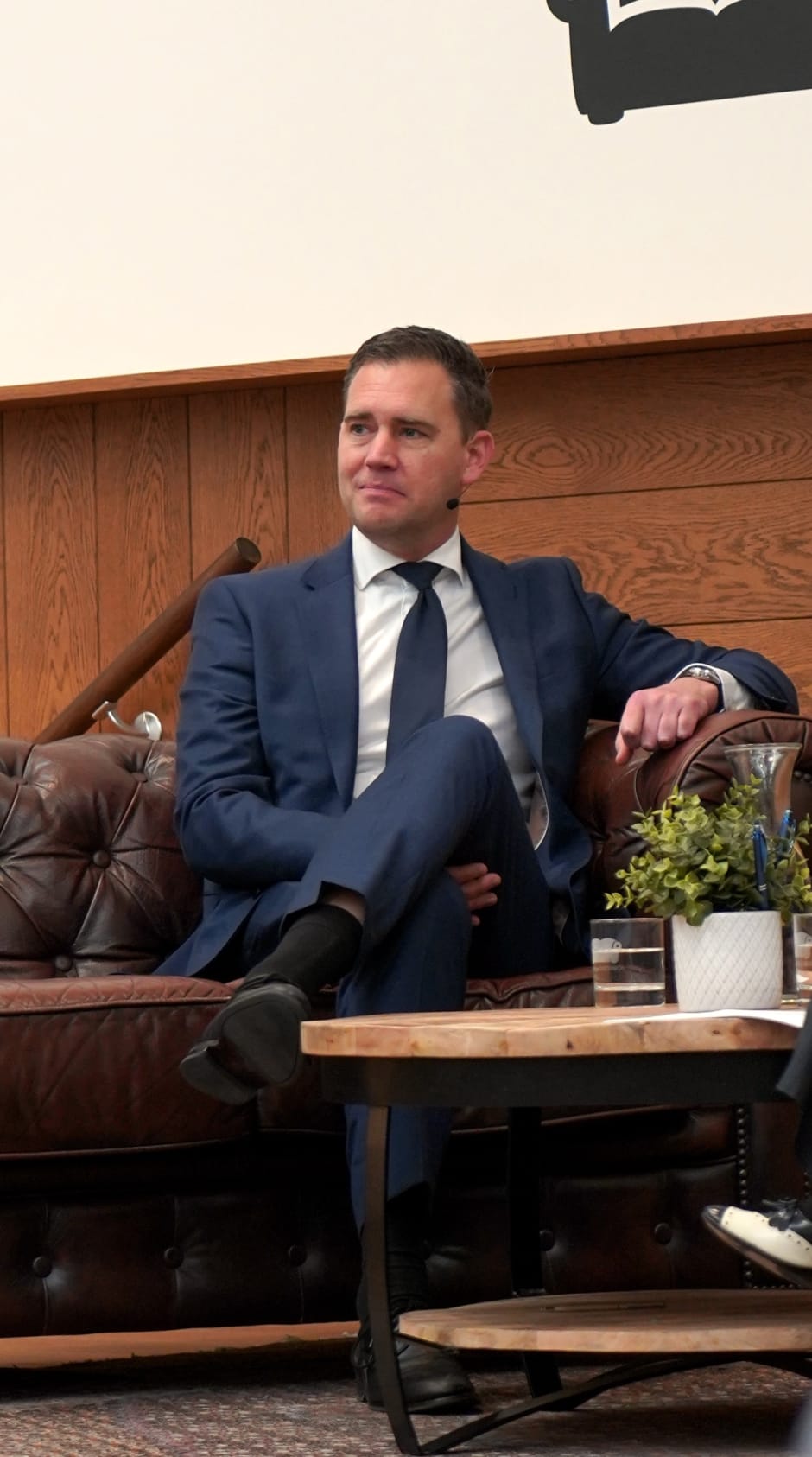
For UvA alumnus Eelco Heinen, it proved to be a pleasant reunion with his alma mater when the caretaker finance minister took his seat in the comfortable armchair on stage on Monday afternoon. With topics centred on sound fiscal policy, the economist was clearly in his element. For the economics students gathered in the lobby of Building E on the Roeterseiland Campus to hear him speak, it was refreshing to see the discussion delve into real substance, though it was noticeable that current political affairs were hardly touched upon.
The interview did begin with a brief look ahead to the coming months, when the ongoing exploratory talks will, in principle, lead to the formation of a new cabinet. Yet when asked whether he could share his thoughts on an ideal coalition, Heinen replied firmly: “No, it’s really a matter of waiting until the dust has settled down.” After that, the VVD politician was not pressed any further on his party’s stance in the exploratory process.
Liberal
Before long, the conversation turns to the topic where Heinen feels most at home: the economy. When asked how the Netherlands should finance the major economic challenges of the coming years – such as the energy transition, an ageing population, and rising defence costs – Heinen repeatedly stresses the need to make “difficult choices.”
“You’re, of course, talking to a liberal here,” he notes. “Spending money is easy, but you always have to ask yourself where that money comes from. Raising taxes on businesses and wealth means taking it away from others. If you don’t want that, spending cuts will be necessary.”
The two students sitting opposite him present new economic theories, but the minister dismisses them as little more than passing trends and hypes. “I studied here at the UvA as well, and in the end it’s very simple: economic growth always stems from innovation. It doesn’t just appear out of nowhere, or by printing more money. It’s about spending less and allowing the market to function independently.” When one of the interviewers remarks that Heinen seems to hold quite a liberal worldview, he counters: “I believe I have two or three hundred years of economic theory on my side to prove my point.”
Heinen also argues for prudency at the European level. Asked for his view on EurobondsEurobonds are bonds issued by a central European agency to finance the national debt of the participating member states., he calls them “absolutely not the way forward.” It cannot be the case, he adds, that the Netherlands ends up paying for the debts of other EU member states. “In theory it might be possible, but in practice I just don’t see it working.” The interviewer wonders whether such a stance risks leaving less prosperous member states behind when large investments – such as those needed for the energy transition – are required. Heinen responds: “I don’t think I’m helping those countries by paying for them. They, too, will have to make the difficult choices that the Netherlands has made.”
Fine for Extended Study
A little later, one of the interviewers notes – somewhat euphemistically – that Heinen is hardly a fan of higher taxes on businesses, though he seems less troubled by VAT increases. Heinen responds: “Even if it doesn’t always feel that way, we are becoming wealthier. Prices in the supermarket are rising, but so are wages.” He stresses that, as a liberal, he prefers lower taxes overall, but argues that indirect taxes such as VAT “are more efficient than, for instance, raising income tax.”
Although the interviewers have clearly done their homework, the most critical question of the afternoon comes from the audience, when a student challenges the minister on education cuts. “If education and innovation are, in your view, the foundations of economic growth, that seems to contradict these spending cuts,” the student remarks. Heinen counters: “The last Rutte cabinets have invested billions extra in education. Even with these last cuts, the net result remains positive.” He also brings up the VVD’s proposal for a fine on extended study periods. “We want to motivate students to work hard and enter the labour market quickly. I don’t see that as an obstacle for innovation.”