Colonial past UvA | Preliminary research outlines involvement in slavery

The UvA was involved in colonialism and slavery in its research and education. This is evident from preliminary research into the UvA’s colonial and slavery past, conducted by the NIOD. The report was presented to the Executive Board on 7 November.

There is reason to conduct further research into the UvA’s colonial and slavery past across the “full breadth of the university’s history”. This is the conclusion of Lauren Lauret, historian and principal researcher at the NIOD Institute for War, Holocaust and Genocide Studies, who spent six months researching the colonial past on behalf of the UvA.
The preliminary research identifies six topics that require further investigation. These are the UvA’s financial and institutional ties, its special collections such as the Allard Pierson Museum, Museum Vrolik and the Zoological Museum, its buildings, its community and its self-image. It is therefore too early to draw any conclusions, according to Lauret. Nevertheless, the report provides an initial picture of the UvA’s links to colonialism and slavery.
Colonial education
The UvA was involved in colonialism and slavery in the field of research and education. The Athenaeum Illustre, the predecessor of the UvA founded in 1632, played an important role in the education of the children of Amsterdam’s nobility. And from 1877, the year the Athenaeum became a municipal university, the UvA had the explicit ambition to include the colonies in its research and education. Lauret: “The universities of Delft and Leiden already had a role in colonial education, and Amsterdam wanted that too.”

There were also professors at the UvA who were involved in the colonies. Lauret: “But we don’t yet know whether this was discussed in the lecture halls. These are questions that need to be investigated in further research.”
“What struck me – and what needs to be investigated further – is how the UvA used the colonies to strengthen its profile,” says Lauret. Just as universities today promote themselves in different ways, this was also the case in the past. “The UvA offered a degree programme in colonial economics, which distinguished the university from, for example, the business school in Tilburg.”
The myth of Barlaeus
As the oldest university in Amsterdam, located in the capital that was the financial centre of the Dutch East India Company, one would expect the UvA’s ties to the colonial past to be obvious. However, Lauret’s research revealed that the reality was often slightly different.
“This starts with the story of the first scholar, Casper Barlaeus, who founded the Atheneum Illustre in 1632. The story that the Atheneum was a small school for training learned merchants has taken on a life of its own. Barlaeus was very good at telling his patrons what they wanted to hear, but the school was not intended to produce learned merchants. It had a very classical curriculum and was intended to teach students to better understand the Bible and such matters.”
East India House
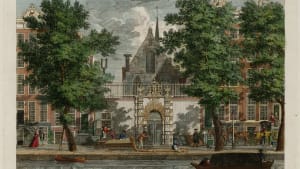
UvA buildings also had ties to colonial activities, such as the East India House, which served as the office of the Dutch East India Company (VOC). However, the UvA did not acquire its buildings through colonial connections. Preliminary research shows that the municipality allocated the buildings to the university. Further research should focus on the question of how decorations in the buildings were related to the colonies.
Criticism of practices in the colonies was also regularly voiced at the UvA. Lauret: “During the appointment of honorary doctors in 1932, for example, critical pamphlets were distributed condemning the appointment of Dutch East Indies colonial oil barons Henri Deterding and Hendrikus Colijn as honorary doctors.” According to Lauret, in order to draw conclusions, it is first necessary to investigate the exact role played by the university.
According to Machiel Keestra, initiator of the research and Central Diversity Officer at the UvA, the link with the history of slavery “turned out to be less significant than expected”. The direct links between the UvA and the Athenaeum Illustre and the plantations and slavery proved to be “less extensive” than he had previously feared and expected. “Compared to some (foreign) universities, our institution was not specifically established for colonialism and slavery, nor was it paid for with specific funds derived from colonialism and slavery.”
This does not detract from the importance of the research, Keestra adds. “The Athenaeum is closely intertwined with the practices and funds of colonialism and slavery. And modern science developed simultaneously with colonialism and imperialism: contemporary research topics, methods and interpretations have emerged from this. I therefore see a major task for all our faculties to look at their current practices and organisation through this mirror of colonial and slavery history.”
Main research
Now that the preliminary research has been completed, the main research can begin. The UvA wants to set up a working group for this purpose via an open call, through which researchers and students can apply.
This working group will carry out the research programme and organise meetings to involve the UvA community and the community of descendants of enslaved people in Amsterdam.
The preliminary investigation recommends that the research be carried out in consultation with the entire UvA community. “Uncovering history only makes sense if it is acknowledged by the people it concerns,” says Lauret.
Ultimately, the aim is to compare the colonial and slavery history of the UvA with that of other Dutch universities that are also researching their own slavery history. But we are not there yet. The main research at the UvA is expected to take several years.